AI Chip Wars Heat Up: Who Will Dominate the Global Compute Race?
futurestackio >> Tech News>> AI Chip Wars Heat Up: Who Will Dominate the Global Compute Race?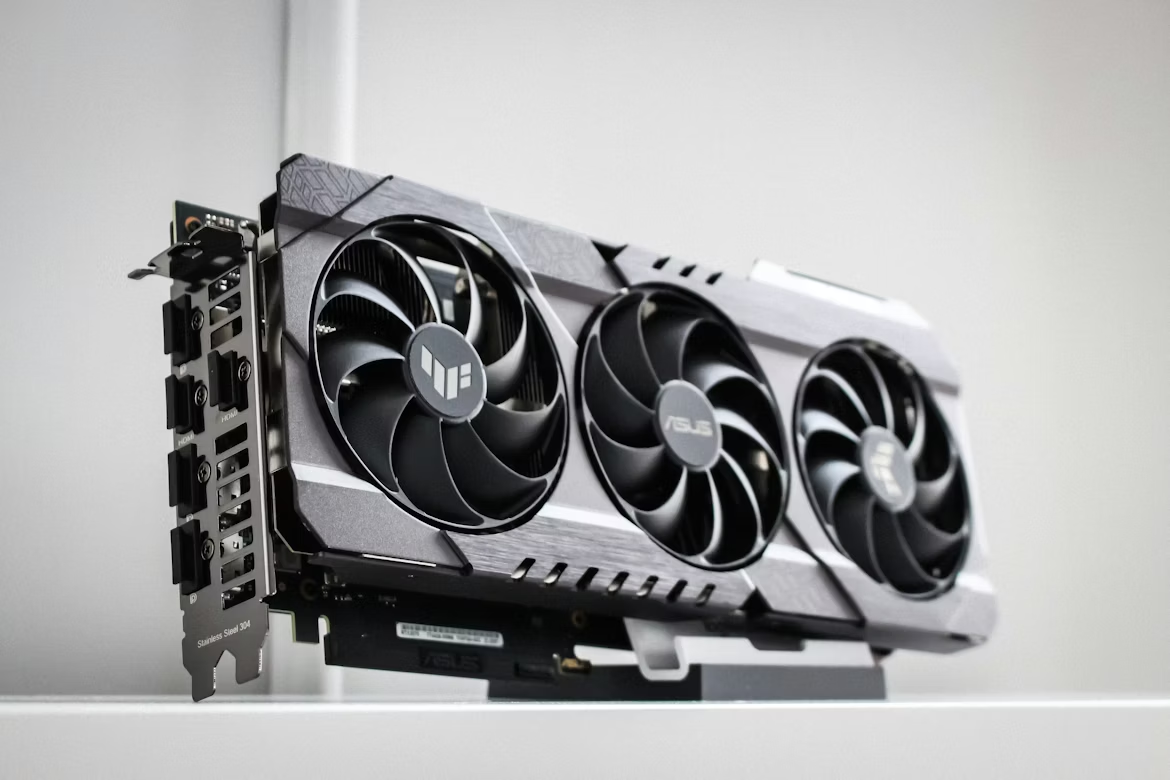
AI Chip Wars Heat Up: Who Will Dominate the Global Compute Race?
The global AI landscape is entering a decisive phase. As artificial intelligence applications expand—from large language models to autonomous vehicles, robotics, and edge devices—the demand for high-performance, energy-efficient chips has never been higher. This surge is fueling what analysts call the AI chip arms race, a competition among tech giants, semiconductor startups, and cloud providers to dominate global computing power.
From GPUs to Custom Accelerators: The Evolution of AI Chips
AI hardware has evolved rapidly over the past decade. Initially, general-purpose GPUs designed for gaming and graphics rendering became the default for AI training workloads. Companies like NVIDIA and AMD adapted their GPUs for parallel processing and neural network optimization, establishing early dominance in AI compute.
By 2022–2023, AI-specific accelerators such as Google’s Tensor Processing Units (TPUs), Graphcore’s Intelligence Processing Units (IPUs), and Cerebras’ wafer-scale engines emerged. These purpose-built chips handle massive matrix multiplications, optimize data movement, and reduce latency, marking the transition from general-purpose GPUs to specialized AI hardware.
Today, in 2026, a new generation of AI chips promises unprecedented performance per watt, lower energy consumption, and faster training cycles for massive AI models. Startups and incumbents alike are racing to push the limits of processing power, memory bandwidth, and interconnect efficiency.
Major Players and Market Dynamics
Several companies are leading the AI hardware race:
- NVIDIA dominates the GPU market, with Hopper and Ada Lovelace GPUs providing massive compute density and optimized pipelines for both AI training and inference.
- AMD leverages its CDNA architecture to compete in GPU and AI accelerator segments, emphasizing scalability and ecosystem integration.
- Intel invests heavily in AI-specific silicon, including Ponte Vecchio GPUs and Gaudi accelerators, offering highly programmable solutions for hybrid workloads.
- Cloud providers like Google, Amazon, and Microsoft develop custom in-house chips (TPU v5, Inferentia, Trainium) to optimize cost, latency, and efficiency.
- Startups such as Graphcore, Cerebras, and SambaNova innovate with wafer-scale designs and AI-focused memory hierarchies, challenging traditional GPU dominance.
Competition is about more than raw performance. Energy efficiency, memory bandwidth, interconnect speeds, and software ecosystem compatibility often decide real-world impact. A chip with high theoretical FLOPS is ineffective if the software cannot fully utilize its architecture.
Compute Demand Surges Across Industries
AI adoption is accelerating across sectors. Large language models, recommendation systems, autonomous vehicles, and robotics drive exponential increases in compute requirements. Training a model with hundreds of billions of parameters can consume millions of GPU-hours, demanding massive data-center deployments.
Cloud providers are scaling rapidly to meet this demand, investing in thousands of GPU clusters and custom accelerators. Hardware shortages have become a limiting factor in AI research, forcing organizations to compete aggressively for chip allocations. The result: surging chip prices and accelerated product roadmaps, intensifying the AI hardware race.
Supply Constraints and Production Bottlenecks
The surge is amplified by slow expansion of memory and chip fabrication. Modern DRAM and AI chip fabs require billions in investment and years of construction. Even when new facilities come online in late 2026 or 2027, ramp-up delays and yield optimization will limit immediate impact.
Meanwhile, older lines have been repurposed or retired, further tightening supply for standard consumer and enterprise modules. The combined effect of constrained supply and growing demand causes price spikes that surpass those seen in previous cycles.
Secondary Markets and Speculation
Speculative activity in secondary markets has exacerbated volatility. Some modules are resold at two to three times their original price, while regional shortages create pressure on retail and OEM channels. For consumers, enterprises, and startups, these dynamics make procurement more challenging, often requiring pre-orders months in advance.
Impact on Consumers and Enterprises
For consumers, RAM and AI hardware costs have jumped dramatically, making previously minor components a major budget factor. PC builders, gamers, and content creators delay upgrades or opt for lower capacities. Laptops and prebuilt systems reflect higher memory costs directly in pricing, particularly in mid-range and high-performance configurations.
Enterprise buyers face even larger pressures. Data centers deploying hundreds or thousands of servers see modest per-module cost increases multiply into millions of dollars. Cloud providers adjust pricing, optimize allocation, and sometimes revise hardware refresh cycles. Research institutions and AI startups face tightened budgets and increased competition for scarce compute resources.
Global Market and Geopolitical Considerations
The AI chip race carries geopolitical significance. Advanced semiconductor fabrication is concentrated in Taiwan, South Korea, and the U.S., raising concerns about supply chain security and technological sovereignty. Governments are investing heavily in domestic AI chip production, aiming to reduce dependence on foreign suppliers.
International competition shapes both industrial strategy and national security. Leadership in AI hardware translates into advantages in research, autonomous systems, and digital infrastructure. The AI hardware market now intersects technology, economics, and geopolitics.
Emerging Trends and Next-Generation Architectures
The next phase of AI chips will feature heterogeneous architectures, combining GPUs, TPUs, FPGAs, and custom accelerators to maximize efficiency for specialized workloads. Memory innovations, including high-bandwidth memory and near-memory compute, will be critical for scaling large models without exponential energy costs.
Edge AI will also expand, requiring smaller, specialized chips for real-time inference in autonomous vehicles, smart devices, and robotics. Success will depend not only on raw performance but on integrated software, energy efficiency, and scalability.
The Path Forward
The AI chip arms race is entering its most competitive stage yet. With surging demand, constrained supply chains, and global competition among both tech giants and startups, the next few years will determine which companies set the standard in AI compute. Firms that combine advanced architectures with efficient, scalable deployment will shape the future of AI hardware. Researchers, enterprises, and investors must navigate this dynamic landscape carefully: leadership in AI will hinge on delivering high-performance, reliable, and cost-efficient computing power at scale.
This competition is no longer theoretical—it is actively reshaping the technology ecosystem. The coming era will define not only which firms dominate AI hardware but also how the next generation of intelligent systems evolves worldwide.