Google DeepMind’s New AI Engine Signals a Step-Change in Drug Discovery
futurestackio >> Advanced Technology>> Google DeepMind’s New AI Engine Signals a Step-Change in Drug Discovery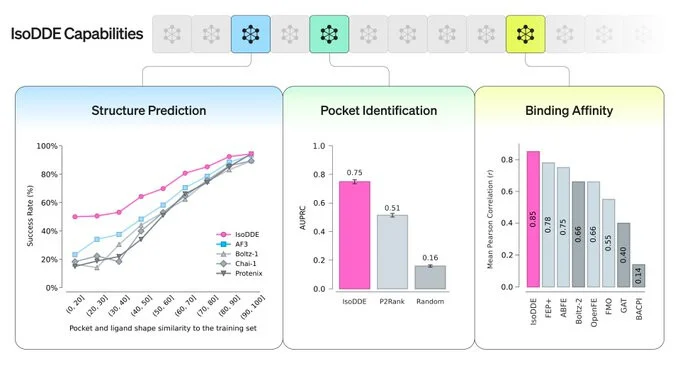
Google DeepMind’s New AI Engine Signals a Step-Change in Drug Discovery
From Incremental Gains to Structural Acceleration
Google DeepMind has unveiled a new AI engine designed specifically for drug discovery, and the claims are striking. According to the company, the system can make parts of the drug development process up to ten times faster, while also improving accuracy and success rates.
At face value, this sounds like another bold AI promise. However, when examined in the context of DeepMind’s previous work—especially AlphaFold—the announcement points to something more structural: a shift from AI as a research aid to AI as a core discovery engine.
Why Drug Discovery Is an Ideal AI Problem
Traditional drug discovery is slow for structural reasons, not just operational inefficiency.
- The chemical search space is enormous.
- Biological interactions are highly nonlinear.
- Experimental validation is expensive and time-consuming.
AI models thrive in exactly these conditions. They reduce search space, learn complex interactions, and prioritize candidates before lab work begins.
DeepMind’s new engine builds on this logic, but extends it beyond protein structure prediction into end-to-end discovery workflows, including target identification, molecule generation, and optimization.
What’s Technically Different This Time
Unlike earlier AI tools that focused on a single stage, DeepMind’s new system integrates multiple models into one pipeline.
Core Capabilities of the New AI Engine
| Stage of Drug Discovery | Traditional Approach | DeepMind AI Engine |
|---|---|---|
| Target identification | Literature + lab screening | AI-driven biological modeling |
| Molecule generation | Manual design + heuristics | Generative models exploring millions of candidates |
| Binding prediction | Wet-lab assays | High-accuracy AI simulations |
| Optimization cycles | Months per iteration | Days or weeks per iteration |
Key insight:
The 10× speedup does not come from doing one thing faster. It comes from compressing multiple feedback loops into a single AI-driven cycle.
This is why the improvement is multiplicative rather than incremental.
Building on AlphaFold, Not Repeating It
AlphaFold solved a foundational problem: predicting protein structures at scale. However, structure alone does not produce drugs.
The new engine treats AlphaFold as infrastructure, not the product. It uses structural data as input, then layers on:
- Generative chemistry models
- Reinforcement learning for molecule optimization
- Multi-objective scoring for safety, efficacy, and manufacturability
In effect, DeepMind is turning static biological knowledge into a dynamic discovery system.
What “10× Faster” Actually Means in Practice
It is important to clarify expectations. This does not mean a drug goes from idea to market in one-tenth the time.
Instead, the acceleration applies to early and mid-stage discovery, where most candidates fail.
- Fewer dead-end molecules enter clinical pipelines
- Promising candidates are identified earlier
- Lab resources are allocated more efficiently
My interpretation:
The real value is not speed alone, but risk compression. AI reduces the probability of expensive late-stage failure, which is the true cost driver in pharma R&D.
Industry Impact: Who Benefits Most
Pharmaceutical Companies
Large pharma firms gain a leverage tool. AI allows them to scale discovery without scaling headcount or lab footprint at the same rate.
Biotech Startups
Smaller teams can compete with incumbents by relying on AI-first discovery models, lowering the barrier to entry.
Healthcare Systems
If discovery becomes cheaper and faster, downstream drug pricing pressure may increase—though this will depend on regulatory and commercial dynamics.
Limits and Open Questions
Despite the progress, this is not a magic solution.
- Clinical trials remain slow and regulated.
- Biological systems still produce unexpected outcomes.
- AI models depend heavily on data quality and coverage.
There is also the question of access. If such engines remain concentrated within Big Tech and a handful of partners, the benefits may not be evenly distributed.
Conclusion
Google DeepMind’s new AI engine represents more than a technical upgrade. It reflects a strategic shift in how drug discovery is approached: from trial-heavy experimentation to model-driven exploration.
The claimed 10× acceleration is best understood as a systems-level improvement, not a headline shortcut. If validated in real-world pipelines, this approach could redefine the economics of pharmaceutical R&D and reshape who gets to innovate in medicine.
AI will not replace biology. But increasingly, biology may be discovered through AI first.