Starship Achieves Key Breakthroughs in Latest Test
futurestackio >> Tech News>> Starship Achieves Key Breakthroughs in Latest Test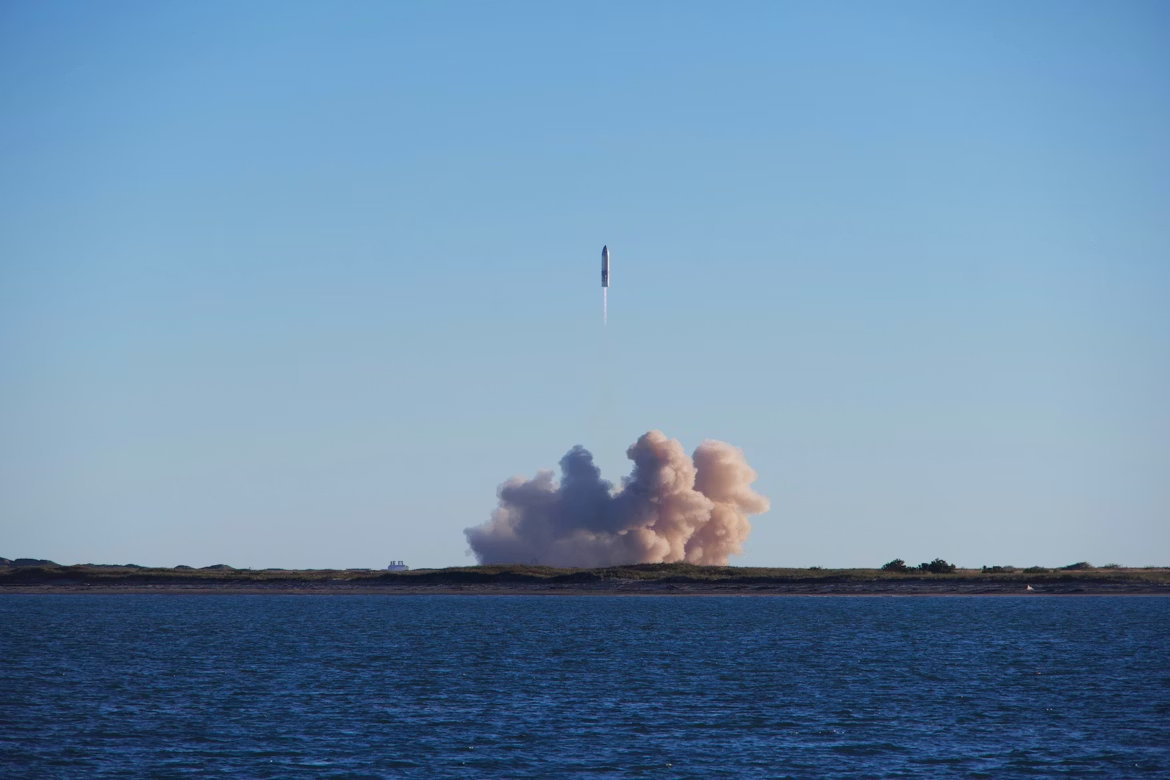
Starship Achieves Key Breakthroughs in Latest Test
Starship Orbital Test Flight Marks Major Progress Toward Full Reusability
The Starship orbital test flight marks another significant step in SpaceX’s long-term effort to build fully reusable, ultra-heavy launch vehicles. In its latest flight campaign, the Starship system completed its third orbital-class test mission and achieved several critical milestones. As the largest and most powerful rocket ever built, Starship represents a fundamental shift in how humanity approaches space access, large-scale payload delivery, and deep-space exploration.
Importantly, this Starship orbital test flight confirmed steady improvements across multiple subsystems. These included propulsion stability, stage separation, guidance accuracy, and high-speed atmospheric flight. Although full vehicle recovery remains an unresolved challenge, the mission demonstrated measurable progress toward operational reliability. Each successful test reduces uncertainty and accelerates the transition from experimental hardware to a reusable launch platform capable of routine missions.
Starship Orbital Test Flight Highlights Scale and Design Philosophy
Starship’s sheer scale sets it apart from every rocket that has flown before. Standing taller than a modern skyscraper and producing unprecedented thrust, the vehicle combines a massive first-stage booster with a fully reusable upper stage. This architecture aims to deliver record-breaking payload capacity while lowering the cost per launch through rapid reuse.
At the same time, SpaceX follows a distinct development philosophy. Rather than slow certification cycles, the company prioritizes frequent iteration, aggressive testing, and fast engineering feedback. As a result, each Starship orbital test flight feeds real-world data directly into the next design revision.
Flight Performance and Stage Separation Improvements
During the latest Starship orbital test flight, the booster executed a controlled ascent with improved engine coordination and structural stability. Compared with earlier attempts, the separation sequence showed more precise timing and cleaner dynamics. These gains reflect refinements in guidance software and mechanical interfaces.
After separation, the upper stage entered a high-energy trajectory designed to simulate orbital conditions. This phase validated thermal protection behavior, navigation accuracy, and onboard systems under extreme aerodynamic stress. Together, these results indicate steady progress toward orbital-class mission readiness.
Engine Reliability and Thermal Management Progress
One of the most important achievements involved sustained engine performance. The Raptor engines maintained consistent thrust and combustion stability across multiple burn phases. This capability is essential for ascent efficiency and future landing maneuvers.
In addition, thermal management systems performed within expected parameters. Heat shielding and structural materials tolerated prolonged exposure to high temperatures and vibration loads. These results strengthen confidence in Starship’s ability to survive repeated high-energy missions.
Control Authority During Hypersonic Flight
Control during hypersonic flight remains a critical focus area. During this Starship orbital test flight, aerodynamic surfaces and control algorithms showed improved stability at extreme speeds. This matters not only for orbital insertion but also for controlled descent and precision landing.
Fine control at hypersonic velocities will ultimately determine whether Starship can support reliable recovery operations and rapid turnaround schedules. Consequently, each improvement in this area brings SpaceX closer to operational reusability.
Recovery Challenges Still Remain
Despite clear progress, recovery and reuse remain the program’s most difficult challenges. Controlled reentry, precise landing trajectories, and post-flight structural survivability require further refinement. SpaceX continues to test new flight profiles and landing strategies to balance safety, performance, and vehicle longevity.
However, every Starship orbital test flight generates detailed telemetry. Engineers use this data to guide hardware redesigns and software optimization, ensuring that setbacks translate directly into measurable improvements.
Broader Impact on Launch Economics
The implications of Starship extend well beyond a single vehicle. If SpaceX achieves consistent reusability at scale, launch economics could change dramatically. Lower costs and higher payload capacity would enable larger space stations, heavier scientific instruments, and faster satellite deployment.
In turn, commercial operators could access capabilities that previously required multiple launches and complex orbital assembly. This shift could redefine how space missions are planned and executed.
Strategic Role in Deep-Space Exploration
Starship also plays a central role in long-term exploration strategies. A reusable heavy-lift system supports sustained lunar operations, cargo delivery for surface infrastructure, and future crewed missions beyond Earth orbit. In-space refueling and large payload transport offer flexibility unmatched by traditional expendable rockets.
As a result, Starship aligns closely with broader industry efforts to establish a permanent human presence beyond low Earth orbit.
A New Model for Aerospace Development
From an engineering perspective, Starship illustrates how modern aerospace development increasingly resembles high-speed software iteration. SpaceX gathers real-world data quickly, accepts controlled failure as part of learning, and integrates improvements at an aggressive pace.
This approach compresses development timelines and allows complex systems to mature faster than traditional procurement models. Consequently, each Starship orbital test flight accelerates progress across the entire program.
Expanding the Boundaries of Space Transportation
The broader launch market continues to watch Starship closely. Competitors, satellite manufacturers, and government agencies are already considering how ultra-heavy reusable systems could reshape mission design and pricing models.
Public interest remains strong as well. Each test flight draws global attention, reinforcing the idea that rapid progress in space transportation can occur within a single decade rather than over generations.
Although challenges remain, the trajectory is clear. With every Starship orbital test flight, technical risk declines and confidence in the architecture grows. As recovery operations evolve, Starship continues to push the boundaries of what is practical in spaceflight, moving large-scale access to orbit closer to routine reality.